As example pricing for mid-2026, a full-size charter bus runs roughly $206 to $327 an hour or $1,331 to $2,841 for a full day. A minibus runs roughly $207 to $246 an hour or $1,098 to $2,105 for a full day.
Those are examples, not quotes. A caterer prices per plate and a hotel prices a block; a bus quote depends on the specifics of your trip, so the answer usually comes back as some version of it depends. But "it depends" has about seven variables in it, and every one of them moves in a direction you can predict before you ask anyone for a number.
For a number on your trip, call 833-458-7001 or fill out the quick form on this website. No account required, no obligation.
The Three Ways a Charter Bus Gets Priced
Charter bus rental is quoted three ways, and the type of trip decides which one you get.
- By the hour. The standard for local work — a wedding shuttle looping between a hotel block and a venue, a conference shuttle circuit, a field trip across town. The clock runs from when the vehicle is committed to your group, not from when the first person steps on.
- By the day. The standard for multi-day trips and long single routes. A day rate covers a defined block of road time and a set mileage allowance.
- By the mile. The standard for long hauls, and often the cheapest structure when a group covers real distance without much waiting around. Per-mile figures commonly cluster around $4 to $7 a mile — again an example band, not a quote.
Most quotes are a hybrid: an hourly or daily base with mileage layered on once you leave the metro. Two companies can hand you wildly different numbers for the identical itinerary just by structuring it differently — one prices your 9-hour day as nine hours, the other prices it as a day rate plus 180 miles. Neither is wrong; they're different products.
Example Charter Bus Rates at a Glance
Find your headcount and read across.
| Vehicle | Example hourly | Example full day |
|---|---|---|
| Sprinter van (12–15) | $203–$273 | Rarely quoted by the day |
| Sprinter limousine (14) | $204–$318 | Rarely quoted by the day |
| Party bus (15–20) | $204–$338 | Rarely quoted by the day |
| Party bus (25–30) | $248–$374 | Rarely quoted by the day |
| Party bus (40–50) | $294–$441 | Rarely quoted by the day |
| Minibus (15–35) | $207–$246 | $1,098–$2,105 |
| Charter bus (40–56) | $206–$327 | $1,331–$2,841 |
Those are example figures to help you plan, not quotes — the quote moves with your date, hours, mileage and how busy that weekend is.
Turn it into a budget line by multiplying the low and the high by your committed hours — six hours on the charter bus row is $1,236 to $1,962. Nudge the band for city and date, roughly 0.9× to 1.15× either way, then add mileage on anything that leaves the metro.
Charter Bus Prices by Vehicle Type
Vehicle class is the choice you control most directly, though it decides what you get for the money more than it decides the rate: Sprinter vans, minibuses and full-size charter buses all start in the same low-$200s example band — roughly $203 to $327 an hour across the three — and only the larger party-bus rows climb above it. What separates the classes is seats, luggage and street access. The rates are in the table above.
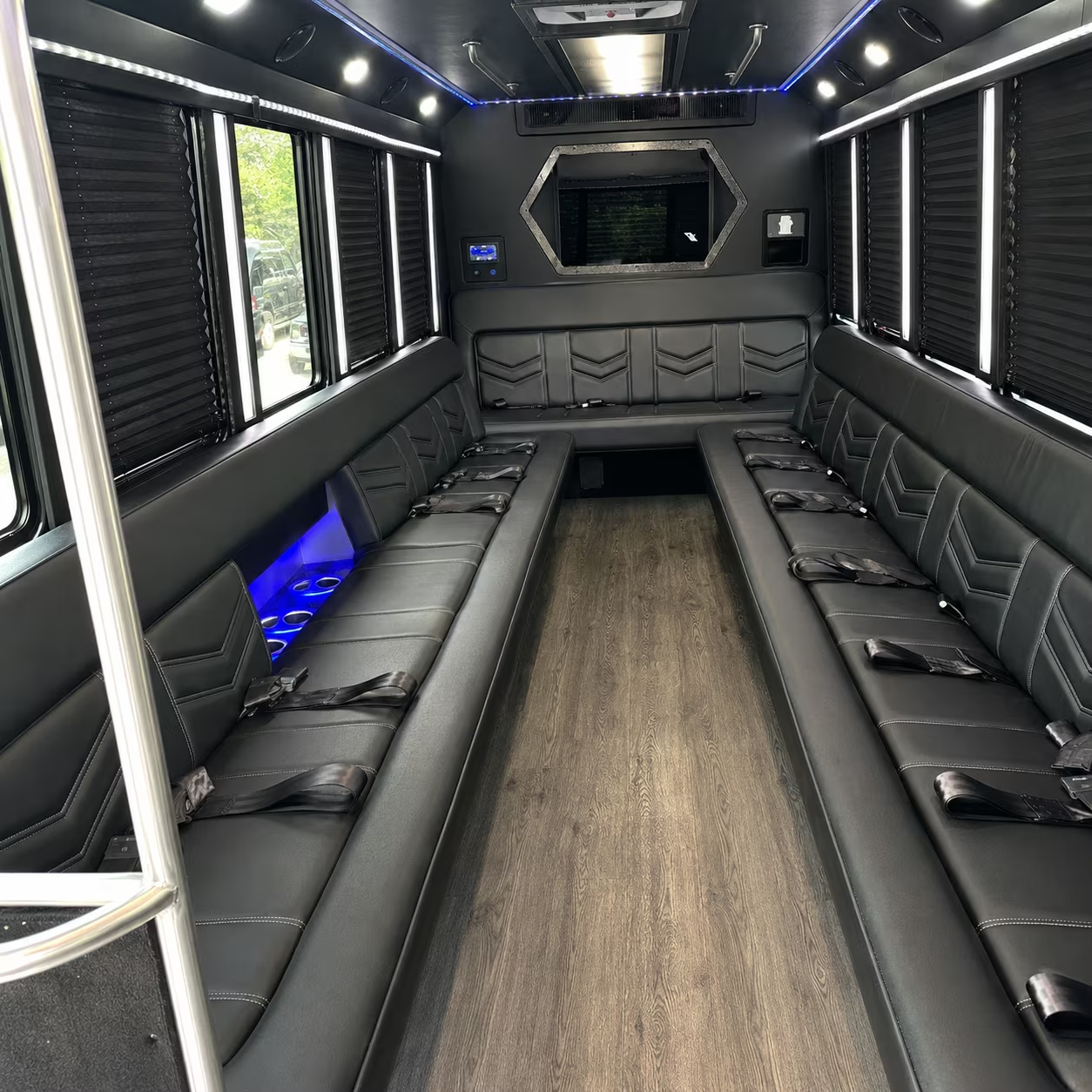
| Vehicle | Seats | Luggage and restroom | Where it makes sense | Where it falls short |
|---|---|---|---|---|
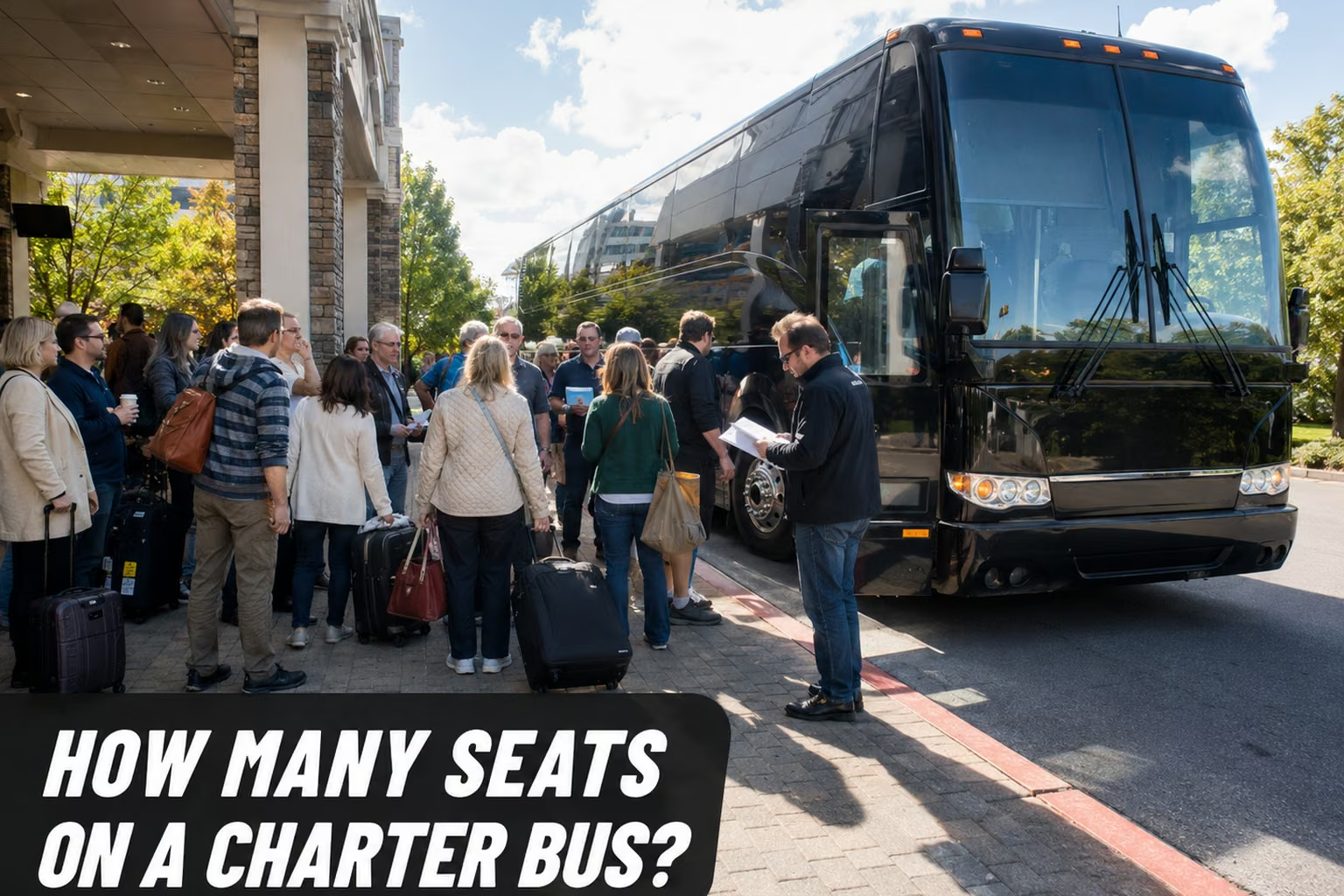
| Full-size charter bus | 40–56 | Undercarriage bays take full suitcases; restroom on most | Long hauls, big fan groups, conventions | Tight streets, low garages, small venue lots. Empty seats are dead money. |
| Minibus | 15–35 | Rear or interior racks, sometimes a small bay. No restroom. | Hotel-to-venue shuttles, downtown loops, repeat circuits | Long interstate legs with luggage; groups that grow past 35 late |
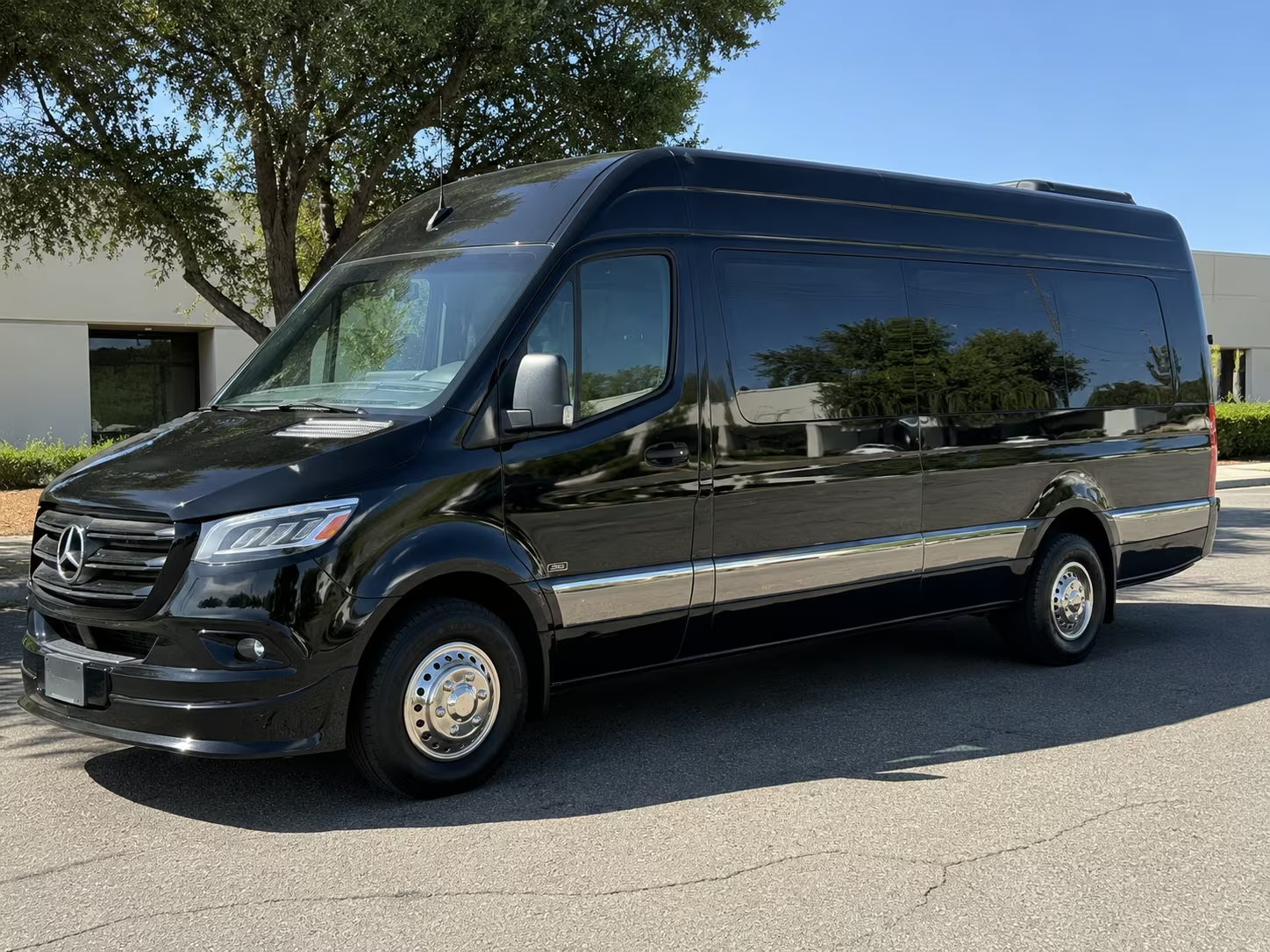
| Sprinter van | Up to 14–15 | Rear cargo area: a few carry-ons plus two checked bags | Executive transfers, airport runs, curbside pickups a bus cannot make | Anything over 15 people, or a group that wants to move around |
| Sprinter limousine | Up to 14 | Minimal — perimeter seating takes the luggage space | Bridal parties and VIP transfers where the ride is the occasion | Airport runs with bags; any trip judged purely on cost per head |
| School bus (where offered) | Up to 72 | No bays, no reclining seats, bench seating | Short local student moves on a tight budget | Adult groups, long distances, anything where comfort matters |
A 56-passenger bus at $206 an hour and a 56-passenger bus at $327 an hour are usually the same vehicle in different cities on different dates. Browse the full lineup of bus types to see what each class carries, or read the breakdown of charter bus amenities if you're deciding whether the restroom and luggage bays are worth the step up.
How to read the photo you get sent. Bay doors along the lower body panel mean real luggage capacity underneath; a smooth flank means bags ride in the aisle. Two rear axles rather than one usually means a 45-footer.
Reclining seats and overhead parcel racks signal a highway coach; flat bench seating signals a shuttle built for short hops. If the photo and the description disagree, get the seat count and model year in writing.
Why the Same Bus Costs Different Money in Different Cities
The same full-size bus, the same eight hours, the same Saturday: a group in Atlanta and a group in New York can be a hundred dollars an hour apart before either has chosen a vehicle. Dense metros add metered bus parking and stretched travel time on top of the base rate.
| Market | Where a full-size bus tends to land | What drives it |
|---|---|---|
| New York | Top of the band, roughly $285–$327 an hour, with day figures near the top of $1,331–$2,841 | Congestion, metered bus parking, dense traffic stretching every hour on the clock |
| Los Angeles | Upper half, roughly $265–$327 an hour | Long crosstown distances and venue access rules that add hours to a short itinerary |
| Atlanta | Middle of the band, roughly $225–$265 an hour | Strong supply across the metro, with spring peaks that bite hard |
| Dallas | Lower half, roughly $206–$258 an hour | Deep vehicle supply and room to move, so rates start lower |
A Dallas group and a New York group planning the exact same eight-hour Saturday can end up around $630 apart on the identical vehicle — that is the bottom of each band, $206 an hour against $285, run out over eight hours. Compare the tops of the bands instead and the gap is closer to $550. A single national number just averages those two groups together, which helps neither.
Dense Northeast markets behave like New York and mid-size metros like Dallas. Find the city that resembles yours, then price your actual date — the service area covers markets nationwide, and the rates page carries the same example bands for party buses.
What Moves the Price, and by How Much
Seven levers do almost all the work on a charter bus quote. Direction and rough magnitude:
| Lever | Direction | Rough magnitude | What you can do about it |
|---|---|---|---|
| Vehicle class | Bigger and flashier costs more | A party bus in the 40–50 range commonly sits well above a plain charter bus of similar capacity, because the interior is the product | Right-size to your real headcount, and decide whether you are buying seats or buying an interior |
| Hours committed | Linear, mostly | Each additional hour adds the hourly rate | Tighten the itinerary; cut dead waiting time between stops |
| Distance | Adds mileage | Commonly $4–$7 a mile beyond the metro | Consolidate pickups into one point instead of three |
| Day of week | Weekends cost more | A 50-passenger charter bus around $206 an hour Sunday–Thursday can reach $327 Friday and Saturday | Move a flexible trip to a weekday and save real money |
| Season | April–June is the peak | Peak-date pricing commonly lands 10–20% above the same trip off-season | Lock the date early; see the booking window further down this guide |
| Market | Dense metros cost more | Roughly 0.9× to 1.15× around the example band | Nothing — but know it before you build the budget |
| Pickup location | Distance from the vehicle's home base adds cost | See the next section | Start the trip where the supply is |
The weekday-versus-weekend figure is the one to show your committee. A 59% swing on the same 50-passenger bus, decided by which day you picked. If your date is even slightly flexible, that saving costs nothing but a calendar conversation.
The Miles Nobody Puts on the Estimate: Deadhead
Here's the cost that rarely makes it onto a pricing page: a bus doesn't live at your pickup point. It lives at a yard somewhere in the metro, and it has to travel to you and travel back afterward — those are deadhead miles, empty miles with nobody on board, and they're part of what your rate is built to cover.
How deadhead shows up. Two groups request the same 6-hour minibus on the same Saturday. One starts downtown, twenty minutes from a yard full of buses.
The other starts from a lake house ninety minutes out. The second group is buying roughly three extra hours of vehicle time before a single passenger boards — and they'll see it in the quote without necessarily seeing the word.
You can't delete deadhead, but you can plan around it. Move the pickup point into the metro and shuttle the outliers in. Request pickup at a hotel block rather than a remote private address.
And when your trip does start somewhere out of the way, say so up front in your quote request, so the numbers you compare reflect the trip you're actually taking.
Two follow-up questions change the total outright. Does the clock start at the yard or at my curb? And if the vehicle sits idle for four hours between the drop-off and the return, am I paying for those hours or is there a layover figure?
On a long gap, releasing the vehicle and booking a second window is sometimes cheaper and sometimes far worse, because it means a second round of empty miles.
Hourly, Daily, or Per-Mile? Match the Structure to the Trip
Pick the wrong billing shape and you pay for time your trip never uses.
| Your trip looks like this | Ask to be priced | Why |
|---|---|---|
| Hotel block to venue and back, one evening | Hourly | Low mileage, high wait time. You are buying the vehicle's presence, not its distance. |
| Conference shuttle running loops all day | Hourly, or a contracted day | Repeat loops rack up hours, not miles. Recurring programs often price better as a block. |
| One-way, 250 miles, drop and go | Per mile | Almost no waiting. Paying for hours means paying for highway time twice. |
| Three-day tournament in another state | Daily | The vehicle is committed overnight. Day rates cover a defined block of road time plus a mileage allowance. |
| Airport pickups spread across an arrival day | Hourly, single window | One vehicle across a consolidated window beats four separate transfers. See airport transportation. |
One structural note on multi-day trips: a three-day quote isn't the one-day quote times three. The vehicle is out of the fleet for the whole block, and overnight lodging near your hotel gets built into the number. Say up front whether the group needs the vehicle standing by in the evenings or only for the transfers, because "available all evening" and "two transfers a day" are very different products at very different prices.
Charter Bus Cost Per Person: The Number That Wins Arguments
"$1,648 for a bus" is a harder sell than "$30 a head," even though it's the same money. Cost per person is the figure that gets a budget approved. The arithmetic is simple:
Total quote ÷ people actually riding = cost per passenger.
Three worked examples using the example bands above:
- Wedding shuttle, 50 guests, 6 hours, full-size bus at $206 an hour. $1,236 total → about $25 a guest for round-trip service between the hotel block and the venue. Nobody parks, and nobody has to skip the party to drive. See wedding shuttle transportation.
- School field trip, 44 riders, 8 hours at $206 an hour. $1,648 total → about $37 a student, which is inside most activity-fund thresholds. See school field trip transportation.
- Corporate offsite, 28 people, 8 hours. On a 56-passenger bus at the top of its band, $327 an hour: $2,616, or $93 a head. On a 35-passenger minibus at the top of its band, $246 an hour: $1,968, or $70 a head. At the bottom of the two bands — $206 and $207 an hour — the same trip lands within a dollar a head either way, so that $23 gap is a top-of-band gap rather than the smaller class being cheaper by rule — which is exactly why it pays to price both sizes instead of assuming.
The practical rule: book the vehicle your headcount needs, not the one your headcount might have needed. Get a firm number before you request pricing, and check the charter bus seating capacity guide if you're between sizes.
Filling every seat has a limit, though. Published capacities assume adults shoulder to shoulder with bags stowed below, so a group traveling heavy should price the next size up too, and let the per-head math decide.
Charter Bus vs. Flying, Vans, and Everyone Taking Their Own Car
A charter bus isn't the cheapest answer for every group.
| Option | What it costs | Where it wins | Where it loses |
|---|---|---|---|
| Charter bus | One quote for the whole vehicle, split across the group | 15+ people going the same place at the same time; cost per head falls as the group grows | Small groups, and long distances where flying is faster |
| Everyone takes their own car | Whatever mileage figure your organization reimburses, multiplied by every car | Under about 10 people going a short distance | Multiplies fast. Eight cars on a 200-mile round trip is 1,600 miles; at a round 75 cents a mile for illustration that is about $1,200 in reimbursable mileage alone — before parking, and about what a six-hour minibus costs |
| Rental vans | Daily rate per van, plus fuel, plus parking at every stop | 10–15 people when someone in the group is willing to take the wheel | Three vans means three arrival times, three parking spots and three people who never get to relax |
| Flying | A per-person fare, times the whole group, plus ground transportation at both ends | Long distance, small groups, tight schedules | A 40-person group is into five figures in fares alone before anyone has arranged a single airport transfer |
Under roughly ten people going a long way, fly. Ten to fifteen people staying local, vans can work if you have willing volunteers. Neither of those groups should be reading a bus quote at all.
Past about twenty people traveling together, the bus is usually the cheapest option per head once mileage reimbursement and parking are in the same spreadsheet — and it's the only one where the whole group arrives at once. That last part has no dollar figure, but it's often the deciding factor: when several cars get separated on the interstate, the event starts late.
Why Charter Bus Prices Moved in 2026
If a rate you saw quoted last summer no longer holds, it probably isn't a bait and switch. Fuel is the operating cost that moves fastest, and a full-size bus burns a lot of gallons over a 400-mile day — when the pump price moves, that lands in quotes rather than getting absorbed. This guide doesn't track fuel prices, so treat the direction as the point and the size of the move as something only your own quote can answer.
Three practical consequences. Older pricing articles are out of date — check the date on any figure you're budgeting against, including this one. Quotes have shorter shelf lives than they used to, so ask how long the number holds and get the answer in the same email as the price.
And ask specifically whether a fuel adjustment can be added later, and on what basis. A quote that can move after you sign isn't the same product as one that can't, and that difference is worth more than a few dollars an hour on the base rate.
What Sits Inside the Number, and What Sits Outside It
Two quotes with the same total can be very different deals, because companies draw the line around "included" in different places. Get each one to confirm which of these sit inside the figure.
| Item | Why it moves the total | Ask it this way |
|---|---|---|
| Fuel and mileage allowance | Day rates bundle a mileage cap; overage bills separately | "How many miles are included, and what is the per-mile overage?" |
| Parking | Bus parking downtown and at stadiums is metered, and rarely trivial | "Is bus parking inside this number?" |
| Gratuity | Sometimes a percentage, sometimes left to the group, sometimes already in | "Is gratuity included, expected, or up to us?" |
| Overtime | Groups run late, and the overtime figure beats the base hourly | "What is the rate if the group runs 45 minutes past?" |
| Shortest billable block | Short trips bill a set block rather than actual time | "What is the shortest block you bill on this vehicle for this date?" |
| Deposit and changes | Sets what putting your date on the calendar commits you to | "What is the deposit, and when can I still change the size?" |
| Wheelchair position | Fewer vehicles are configured for it, and a lift replaces seats | "Can you seat a wheelchair position, and what does it cost in seats?" |
Two of those deserve extra planning. Ask for a wheelchair position when you request pricing, ideally 48 hours or more ahead, since far fewer vehicles are configured for it and a lift replaces two to four seats — which changes the capacity row you should be pricing. And watch the minimums: most companies bill a shortest block rather than actual time, so a two-hour job can come back priced as three or four hours.
It varies by company, vehicle and date, which is why the question in the table above is worth asking outright rather than assumed.
Rental Minimums, and Why They Move With Your Date
A minimum is the shortest booking a company will take. The individual bus company sets it, never this website, and it differs from one company to the next — a question to ask, not a rule to count on.
What moves a minimum is the date and the event type. On an ordinary weekday transfer many companies bill close to the hours you use; some price a short transfer flat. On a date they can fill twice over — prom season, a wedding Saturday, homecoming, a big local event — the same company commonly sells a package with a longer floor, and the shortest billable block stretches with it.
The reason: on a date it could book twice, a short booking costs the company the rest of the evening.
A long minimum at one company is not the end of it. Because this website compares several companies on one date, you can see what another quotes rather than accept the first floor you are handed.
Ask what the minimum is for your date before you compare totals. The same company can answer one way for a Tuesday and another for a prom Saturday.
When Charter Bus Prices Spike, and When to Lock Your Date
Demand for buses isn't spread evenly across the calendar. It stacks into a handful of predictable windows, and inside those windows availability disappears before price even becomes the issue.
- April through June is the industry peak. Proms, graduations and class trips all land in the same ten-week stretch, and every school district in a metro is bidding for the same vehicles on the same Fridays. Get pricing three to six months out for any spring date.
- Summer Saturdays. Wedding season collides with tournament season, and that's where the weekday-to-weekend spread bites hardest.
- Fall football weekends. In a college town or a pro market like Nashville, home game Saturdays clear out the local supply of full-size buses. Look at the schedule before you look at rates; the sporting event transportation page covers how those trips get built.
- Holiday weekends. Memorial Day, Fourth of July, Labor Day, New Year's Eve. Short supply, long lead times, no last-minute bargains.
- Citywide conventions and festivals. When a metro hosts something that fills its hotels, it also empties its bus yards. Convention-heavy cities such as Boston can price like a peak weekend in mid-October, so treat any date that overlaps a major event as a peak date regardless of season.
Outside those windows, two to four weeks of lead time is usually workable. Inside them, waiting doesn't just cost more — it can cost you the vehicle size you actually needed, which is a worse problem than a higher rate.
How to Get the Best Charter Bus Rate
Six things that move your number:
- Right-size the vehicle, and price both sizes. Twenty-eight people on a minibus instead of a full-size bus came out $23 a head cheaper at the top of the bands in the example above — the two classes start from the same hourly figure and only separate higher up, so the only way to see which is cheaper on your date is to ask for both.
- Move the date if you can. Weekday instead of weekend, off-season instead of April through June — the 59% swing from earlier, on the identical vehicle.
- Consolidate the pickups. Every extra stop is time on the clock. One hotel lobby beats four home addresses, and it shortens the deadhead run too.
- Match the billing structure to the trip. Ask for the same itinerary priced hourly and again per mile, then compare the two totals rather than the two rates.
- Get the date on the calendar early. Lead time is the cheapest lever you have, and it costs nothing.
- Compare more than one option. The same trip priced by different companies comes back structured differently and priced differently — and you can't see that from a single phone call.
The last point invites the obvious objection: why go through a comparison website instead of calling a bus company?
It's a fair one. If you already have a company you've used and liked in your city, calling them directly is faster than any form, and knowing who picks up the phone is worth something on a date when vehicles are scarce.
But calling one bus company gets you one company's structure, one company's availability and one company's number. Everything above is a list of ways those three differ. Instead of calling company after company and waiting on callbacks with quotes that never quite line up, you fill out one quick form and compare vehicles and online rates from a large network of bus companies in seconds.
Partybus-rental.net compares quotes and connects groups with the bus companies and transportation providers serving each area; it does not own vehicles, employ anyone at the wheel, or operate trips, and the amounts shown here are example pricing.
Vague requests also get vague pricing. Six lines are enough to get comparable numbers back, and the same six paste straight into a budget request.
The six lines worth writing down.
- Vehicle and headcount — the class you want, the confirmed rider count, and "price the next size up as well."
- Date and committed window — the date, the time the vehicle should reach the first curb, the time you expect to release it.
- Actual addresses — every pickup and drop in order, real streets rather than "downtown," so the empty miles get priced honestly.
- Luggage and equipment — bag count plus anything bulky. Bays that take crates are not standard on every vehicle.
- Accessibility needs — a wheelchair position, a lift, or a seat close to the door, in the first message rather than the last.
- Your range, the structure, and how long the price holds — "we budgeted an example $1,331 to $2,841 for a full day; price it hourly and again as a day rate plus mileage."
The single national bus price is a stubborn idea, and it's easy to see why people expect one. Every other line on an event budget behaves that way. Catering is per plate, hotel rooms are per night, the venue has a Saturday rate.
A bus is priced per trip — and the trip is yours alone.
How This Guide Was Put Together
The rate ranges on this page are the example planning bands published across this website. They're illustrative planning figures for budgeting — not offers, not quotes, and not a survey of current market rates. No first-party booking data is used.
Where the guide weighs a bus against cars, vans or flights, the arithmetic is illustrative: round mileage and fare assumptions are labeled as examples, so substitute the numbers your own organization uses.
Limits worth stating. Companies structure quotes differently, so an hourly figure and a day figure aren't strictly comparable. Four metros is a thin sample for a country this size, and rates move with fuel, season and local demand.
Capacities and features vary by model year and by fleet, so confirm the configuration on your own quote. If a figure here has drifted, flag it through the contact page linked at the end of this guide. For a smaller vehicle, the party bus cost guide runs the same math, and how to rent a bus covers the booking steps end to end.
Frequently Asked Questions About Charter Bus Prices
How much does a charter bus cost per hour?
As example pricing for mid-2026, a full-size charter bus runs roughly $206 to $327 an hour and a minibus roughly $207 to $246 an hour, with dense metros like New York and Los Angeles sitting at the top of those bands and peak weekends running higher still. A party bus in the same capacity range reaches higher at the top, roughly $204 to $441 an hour depending on size, because the interior is the product. Examples to help you plan, not quotes.
How much does it cost to rent a charter bus for a day?
Full days run about $1,331 to $2,841 for a full-size charter bus and about $1,098 to $2,105 for a minibus as example pricing, with the higher end reflecting big-metro and peak-date figures. Long-distance days also carry mileage, commonly $4 to $7 a mile. A multi-day trip isn't simply the day rate multiplied out, because the vehicle is committed overnight — give the full itinerary when you request pricing so the number you compare is the one that applies.
How much is a charter bus per person?
Divide the quote by the people actually riding. A 6-hour full-size bus at $206 an hour is $1,236, which is about $25 a head across 50 guests and about $41 a head across 30. Cost per passenger is the metric that gets budgets approved, and it improves with every seat you fill — which is why booking a bus larger than your headcount is an easy way to overspend.
Why did two companies quote such different prices for the same trip?
Usually because they structured it differently, not because one is overcharging. One may have priced your day hourly while the other priced it as a day rate plus mileage. Distance from the vehicle's home base differs too, which changes the empty miles built into the rate, and one total may already include gratuity while the other adds it later.
You're comparing structures, not just totals.
Is there a minimum number of hours to rent a charter bus?
Often, and the individual bus company sets it, not this website. Minimums move with the date and the event type: an ordinary weekday transfer commonly carries a short floor or none, while peak dates such as prom Saturdays and wedding weekends are sold as packages with a longer one. Ask what the minimum is for your exact date; the same company can answer differently for a Tuesday and a prom Saturday.
If one floor is longer than your trip needs, see what another quotes.
Does my pickup location change the price?
Yes, and more than most people expect. Buses are based at yards, and the empty travel to reach you and return afterward is part of what the rate covers. A pickup ninety minutes outside the metro can add hours of vehicle time before anyone boards.
Starting from a downtown hotel instead of a remote address is a real saving.
Is a charter bus cheaper than flying?
For a group, usually. A single domestic fare times forty people puts a group into five figures before anyone has arranged ground transportation at either end, while one bus is a single quote split across the same forty. Below about ten people covering long distance, flying generally wins on both cost and time.
Above about twenty, the bus wins on cost and wins outright on everyone arriving together.
Is a charter bus cheaper than everyone taking their own car?
Once you count mileage properly, often yes. Use whatever mileage figure your organization reimburses against. As an illustration, eight cars on a 200-mile round trip is 1,600 miles, or about $1,200 at a round 75 cents a mile — roughly the cost of a six-hour minibus, before anybody pays for parking at the destination.
What size bus does my group need?
Match seats to your confirmed headcount rather than your invite list. Sprinter vans carry up to about 14 or 15, minibuses 15 to 35, and full-size charter buses 40 to 56. Full-size buses add undercarriage luggage bays and an onboard restroom, which matter on long hauls and matter very little on a 20-minute hotel shuttle.
The guide to bus types lays out the differences, and if you're between sizes, get pricing on both.
When are charter bus prices highest?
April through June is the industry's peak season, driven by proms, graduations and class trips landing in the same short window. Summer Saturdays, fall football weekends, holiday weekends and citywide convention dates follow. Day of week alone can move a 50-passenger bus from around $206 an hour Sunday through Thursday to $327 Friday and Saturday — a 59% swing.
How far in advance should I get pricing?
Three to six months for spring dates, summer Saturdays, holiday weekends and anything overlapping a major event in your city. Two to four weeks is usually workable outside those windows. Getting pricing costs nothing and takes about a minute, so there's no advantage to waiting — and inside peak windows, late requests lose the vehicle size before they lose the rate.
Are the prices on this page a quote?
No. They are example figures to help you plan, and they will move with your date, city, vehicle and itinerary. They are here so you can build a budget that survives contact with reality. For an actual price on your trip, call 833-458-7001 or use the online quote form — no account required, no obligation.
Does Partybus-rental.net own the buses?
No. Partybus-rental.net is a comparison and quote-request website. It displays vehicle types and example pricing available across a large network of bus companies so you can weigh options in one place — which means you're never limited to whatever one fleet happens to have free on your date. More on how this website works, or browse the FAQ page.
Get Your Charter Bus Price in About a Minute
Ranges are for planning. Your trip has a date, a city, a headcount and a pickup point, and those four things produce a number no article can. Whether you're moving a wedding party between a hotel block and a venue, running a corporate shuttle across a three-day conference, hauling a team to a tournament two states over or organizing group transportation for a reunion, Partybus-rental.net makes it easy to compare charter buses, minibuses, Sprinter vans and party buses side by side.
Call 833-458-7001 any time, any day, or fill out the quick form on this website. Free quote, no account required, no obligation — and a quote instead of a range.
Rate figures on this page are example planning bands used across this website,. Rates move with fuel, season, city and local demand, and fleets revise vehicle configurations between model years, so confirm the exact figure and specification for the vehicle on your quote. Partybus-rental.net is a comparison and quote-request website — it does not own vehicles and does not provide the transportation itself. Corrections: contact page.