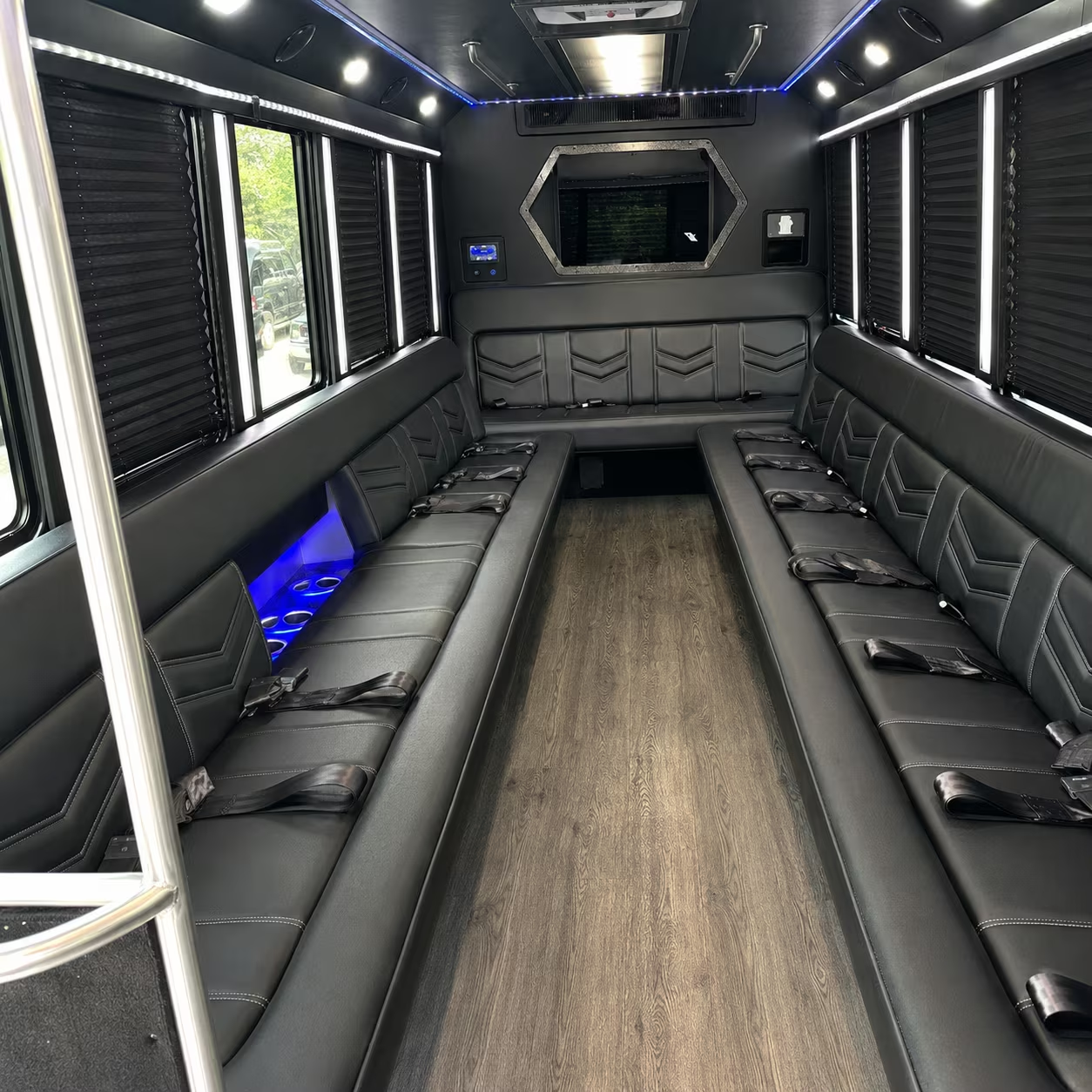
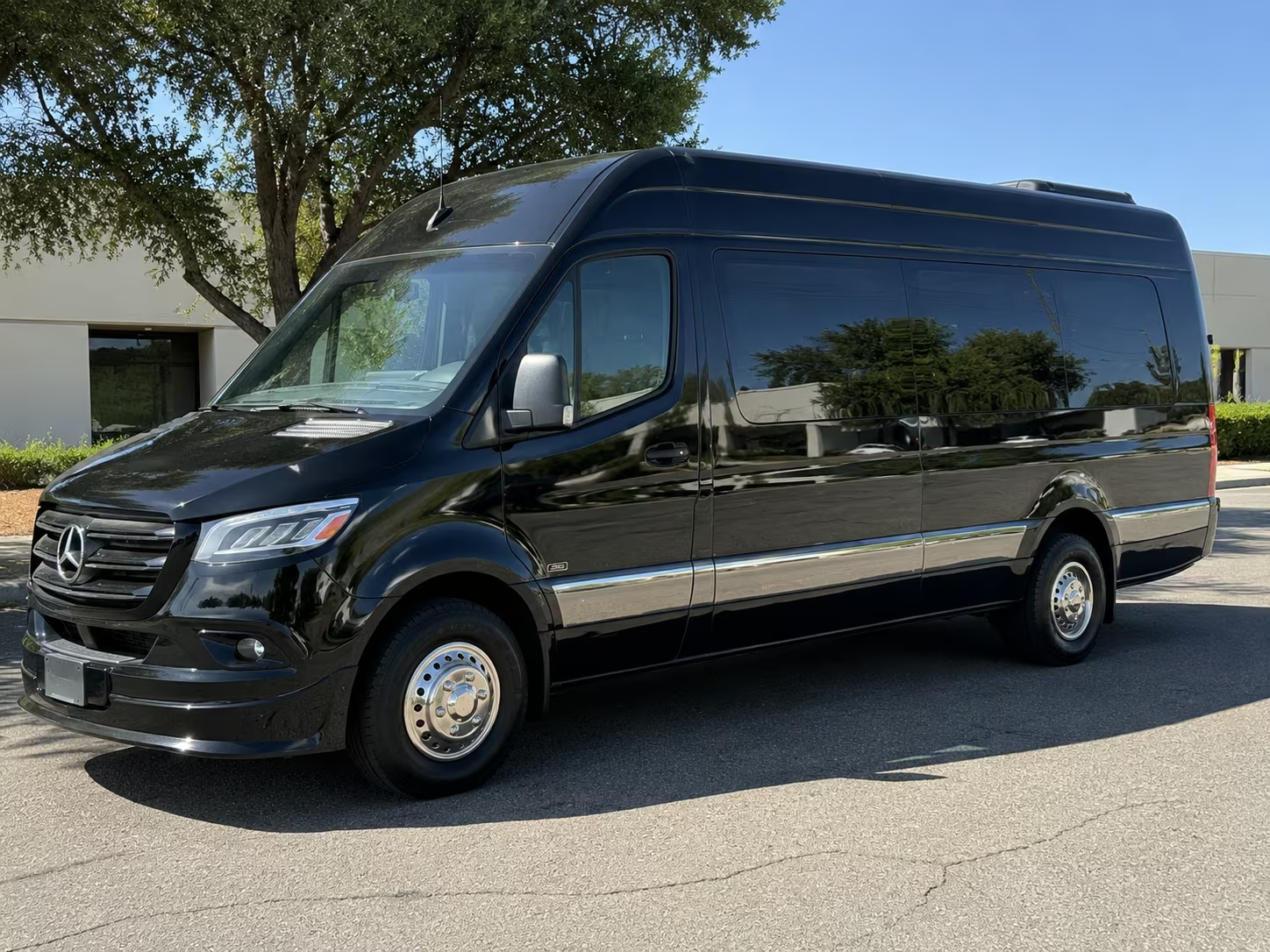
A charter bus is a bus hired whole by one group for one itinerary at a negotiated price, with your group setting the route and the schedule. That names the arrangement, not the vehicle. It's why one quote for a "charter bus" can be a 45-foot coach with 56 reclining seats and 445 cubic feet of luggage space underneath, and the next quote, for the same Saturday, can be a 28-foot minibus with 25 seats and a rack by the back door.
Say "charter bus" and a picture arrives with it: 45 feet, tinted glass, bay doors down the flank. Fair guess. But it's a billing word — it tells you how the vehicle is paid for, not what pulls up.
Not a length. Not a seat count. Not a restroom.
Which means the specification is yours to supply. Five things settle it: headcount, bag count, restroom or no restroom, total hours, and any height limit at your pickup or drop. The bus types guide maps the vehicle classes side by side.
Charter Bus, Motorcoach, Minibus: Which Word Names What
The same coach can run a charter one day and a ticketed route the next without changing a bolt. Here are the words people mix up:
| Term | What it names | Example |
|---|---|---|
| Charter bus | The arrangement: one group hires the whole vehicle for one itinerary | A 56-seat coach booked for a Saturday wedding |
| Motorcoach or coach bus | The vehicle: a raised passenger deck over enclosed luggage bays | MCI J4500, Prevost H3-45 |
| Over-the-road bus | The industry term for that same build | Same vehicle, technical name |
| Scheduled service | The opposite arrangement: ticketed seats on a published timetable | The same coach, different contract, next day |
A motorcoach running a ticketed route isn't a charter bus. A minibus hired whole by your group is a charter bus rental and isn't a motorcoach.
So ask for four items before you compare on price: year, make and model, seat count, and published luggage volume.
You can read the class straight off the photo:
- An integral coach: one continuous body, a high window line, long luggage-bay doors along the lower flank, and three or four steps up to a raised deck.
- A cutaway mini coach: a factory truck or van nose with a visible seam where the body starts behind it, one or two low steps at the door, and no bay doors — only a rear luggage door.
Low floor and no bay doors means bags ride in the aisle, whatever the seat count says. The minibus guide covers that class.
How Many People Fit on a Charter Bus?
Full-size charter buses seat 55 or 56 as standard, up to 60 on builds ordered with tighter seat pitch. Mid-size integral coaches run 34 to 44, cutaway mini coaches 15 to 44, passenger vans 12 or 15.
Seat count alone isn't enough. On most of these vehicles, seats and luggage come out of the same budget:
- Grech's GM40: up to 40 passengers with rear luggage; its EG40 sibling on the same Freightliner S2 chassis takes 44.
- Grech's GM33: up to 28 with rear luggage, 32 without.
- Prevost H3-45: 460 cu ft of bays drops to 430 once a wheelchair lift is fitted.
- Van Hool CX45: 440.4 drops to 360.8 with a lift.
- MCI J3500: 285 drops to 270 with a rear lift.
Count riders and bags as two separate numbers, and put both in the request. The two configurations look identical from the curb; Grech Motors publishes both for its GM33. More on that in the seating charter bus capacity guide.
Do Charter Buses Have Bathrooms?
Yes on every current full-size touring coach reviewed here. Usually yes on integral mid-size coaches. Rarely on cutaway mini coaches, shuttles and vans.
That's what the builders print, not a generalization. Prevost lists Lavatory: Standard on both the H3-45 and X3-45 specification sheets. MCI's J-Series brochure lists a chemical lavatory as standard on the J4500 and J3500 in every trim, with a secondary holding tank as the option.
ABC Companies' CX45 spec sheet shows a toilet with a supplemental holding tank. Temsa publishes tank capacities: 10 gallons plus an extra 15 on the TS45, 12 plus 12 on the TS35, 12 on the TS30.
Two caveats. Commuter- and transit-specified 45-footers are routinely ordered without a lavatory, so "45 feet" alone doesn't mean one is fitted. And on a cutaway mini coach, a restroom exists only if the body builder fitted one, which costs seats.
What this does to your day. A four-hour run with 50 people and no onboard restroom isn't a four-hour run. It's two stops, and 50 people through one gas station bathroom costs roughly 20 minutes each time.
Over about 90 minutes without a natural break, specify an integral coach or build the stops into the schedule. Either answer is fine — what costs you is discovering it at mile 40.
Charter Bus Sizes and Specifications, Model by Model
When a quote says "56-passenger coach," it almost always names one of these.
| Model | Class | Length | Overall height | Standard seats | Underfloor luggage, no lift / with lift | Overhead racks | Restroom |
|---|---|---|---|---|---|---|---|
| Prevost H3-45 | Full-size touring | 45 ft | 146.25 in (12 ft 2 in) | 56 | 460 / 430 cu ft | 117 cu ft | Standard |
| Prevost X3-45 | Full-size touring | 45 ft | 133.875 in (11 ft 2 in) | 55 | 380 / 350 cu ft | 107 cu ft | Standard |
| MCI J4500 | Full-size touring | 45 ft 7 in | 141.75 in (11 ft 10 in) | 56, up to 60 | 445 / 430 cu ft | 131.2 cu ft | Standard |
| Van Hool CX45 | Full-size touring | 45 ft | 11 ft 6 in | 56 | 440.4 / 360.8 cu ft | 87.5 / 84.4 cu ft | Yes |
| Temsa TS45 | Full-size touring | 45 ft | 11 ft 6 in | 56 + courier seat | 460 cu ft | Enlarged racks | Yes |
| Volvo 9700 US/CAN | Full-size touring | 45 ft | 12 ft 1 in | 54 (56 in the non-lift layout) | 411 cu ft | — | Yes |
| MCI J3500 | Mid-size integral | 35 ft 10 in | 141.75 in | 40, up to 44 | 285 / 270 cu ft | 92.3 cu ft | Standard |
| Temsa TS35 | Mid-size integral | 35 ft | 11 ft 7 in | 40 | 215 cu ft | Standard | Yes, recirculating |
| Temsa TS30 | Mini coach, integral | 31 ft 1 in | 11 ft | 34 + courier seat | 190 cu ft | Standard | Yes, recirculating |
| MCI D45 CRT LE | Low-entry commuter | 45 ft 10 in | 138 in (11 ft 6 in) | 54 | Substantially less than a touring coach | — | Optional |
To turn cubic feet into bags: a large checked bag takes roughly 4.5 cu ft and a carry-on about 1.6, then discount around a third for how bays actually pack. That puts a 445 cu ft J4500 at comfortably more than a full coachload of checked luggage, a 285 cu ft J3500 at about 40 checked bags, and a 190 cu ft TS30 at roughly 27.
Forty people flying in for a conference bring 40 checked bags and 40 carry-ons — that's a full-size coach, whatever the seat count allows. Forty people going eleven miles to a reception bring handbags, and the mid-size coach is the better buy.
The dividing line is construction, not length. Integral construction — the raised deck over enclosed bays — scales down to 31 feet. A cutaway is a body bolted to a truck chassis with a low floor, so there's nowhere for bays to go at any length.
If a quote says "35-foot minibus," ask which of the two it is.
Two model notes that date a quote. MCI announced in March 2026 that the J4500 became the top-selling motorcoach in 2004 and has been the most widely purchased new coach in the US and Canada every year since except 2020, when it placed second by under one percent, per the American Bus Association's Motorcoach Builders Survey — the announcement sits on MCI's own site and the survey on the association's industry pages. And Daimler ended MCI's Setra distribution agreement in 2018 and moved sales to its own North American distributor; the line has since been replaced by the Mercedes-Benz Tourrider, so a Setra S 417 is a used-fleet coach, not a current build.
The charter bus manufacturers guide covers who builds what.
One caveat on every number above: published figures for the same model disagree, because seat pitch, tank size, interior package and lift fitment all change them, and model years change them again. MCI's own brochure puts J4500 below-floor baggage at 445 cu ft while resale listings for older units quote 455 and 595. Narrow the class here, then confirm the configuration offered for your date.
Charter Bus Dimensions: 45 Feet Long, 102 Inches Wide, 54,000 Pounds
How long is a charter bus?
Forty-five feet. That's the standard across the full-size class: the Prevost H3-45 and X3-45, the Van Hool CX45 and the Temsa TS45 all measure 45 feet, and the MCI J4500 runs 45 ft 7 in bumper to bumper. Two shorter builds sit under it.
A 40-foot coach, of which MCI's D4020 is the current example, keeps the same body and gives up a section of wheelbase. A 35-foot coach — the J3500 at 35 ft 10 in, the Temsa TS35 at 35 ft — gives up roughly a third of the hold and buys back the turn: MCI publishes the J3500 at a 32 ft 10 in turning radius against the J4500's 40 ft 11 in.
How wide is a charter bus?
102 inches, or 8 ft 6 in, and length doesn't change it. MCI's D-Series specification sheet publishes 102 inches of overall width for the 40-foot D4020 and the 45-foot D4520 alike, and the 35-foot J3500 is the same 102 inches. Mirrors stand outside that body width, so the clear space a coach needs on a narrow lane or a tight loop is wider than the sheet says.
How tall is a charter bus?
Between 11 ft 2 in and 12 ft 2 in by model, with most of the class landing at 11 ft 6 in to 11 ft 10 in. Shorter coaches are not lower coaches: the 35-foot J3500 stands 141.75 in, exactly as tall as the 45-foot J4500. MCI's D-Series sheet lists 138 in overall against 78 in of interior height, which is where the difference goes.
How much does a charter bus weigh?
A full-size charter bus is rated at 54,000 pounds gross vehicle weight — 27 tons. MCI publishes that rating on its D-Series specification sheet, and publishes the identical 54,000 lb for the 40-foot D4020, because the three axles underneath don't change when the body gets shorter. Curb weight, what the empty vehicle actually scales at, is rarely published by any builder.
The rating earns its keep in one place: posted weight limits on parking decks, small bridges and private drives, plus any pickup point on grass or gravel. If your route crosses one, read the posted number and put it in the request next to the height.
Charter Bus Height Runs 11 ft 2 in to 12 ft 2 in
Tallest first:
- Prevost H3-45: 146.25 in, about 12 ft 2 in
- Volvo 9700 US/CAN: 12 ft 1 in
- MCI J4500: 141.75 in, about 11 ft 10 in
- Van Hool CX45 and Temsa TS45: 11 ft 6 in
- Prevost X3-45: 133.875 in, about 11 ft 2 in
At 11 ft 6 in the TS45 clears a 12-foot door with six inches to spare. An H3-45 doesn't.
So if any part of your itinerary passes under a hotel porte-cochère, a garage entrance or a covered campus drive, get the posted clearance and put the number in your request.
This is where the X3-45's smaller bays pay off. It trades 80 cubic feet of luggage for a foot of clearance and gives passengers 79.5 inches of headroom against the H3-45's 77. The taller coach exists for sightlines on touring work.
Canopies and parking-structure entrances carry the number on the beam, so photograph the sign. If nothing's posted, name a street-level pickup point instead — a coach that can't reach the canopy stops at the nearest curb.
Which Equipment Is Standard and Which Was Ordered
Prevost lists as standard on the H3-45 and X3-45: lavatory, PA system, LED lighting, open parcel racks, reading lamps — plus navigation on the H3-45. Listed as optional: WiFi, 110V outlets with USB, HD monitors, DVD, enclosed parcel racks, tray tables, window blinds. The full sheets are published on Prevost's site.
MCI's grid goes further. "Wi-Fi system" is an option on the base coach, and it isn't in the Preferred Spec or High Spec packages either — yet every J-Series coach ships with a power supply pre-installed in the parcel rack for a WiFi installation. Wired for it, every one of them, whether or not anyone ordered the system.
The 110V outlets with USB at every seat, with their 4,000-watt inverter, are optional on the base coach and typically included in the Preferred and High trims.
Temsa breaks the pattern the other way: the redesigned TS45 builds dual USB-A and USB-C outlets into the passenger seating, as its model brochures show.
| Feature | Full-size coach | Cutaway mini coach | What to do |
|---|---|---|---|
| Underfloor luggage bays | Structural, always | Not built in | Say your bag count |
| Reclining seats, armrests | Standard | Varies by body builder | Matters past 90 minutes |
| Overhead parcel racks | Standard, 84–131 cu ft | Sometimes | Where carry-ons go |
| Onboard restroom | Standard on touring builds | Rare, costs seats | Name it if the route is long |
| WiFi | Optional on every sheet reviewed | Optional | Ask by name, always |
| 110V and USB at the seat | Varies: optional on Prevost and base MCI, in MCI's upper trims, built into the TS45 | Optional | Ask by name |
| Monitors and DVD | Optional to standard by builder | Optional | Confirm for school groups |
The "ask by name" rows are where two quotes at the same price come apart. Get them confirmed on the specific vehicle, not the model. Wired for WiFi is not WiFi.
The charter bus amenities guide goes row by row.
A Wheelchair Lift Costs You 15 to 80 Cubic Feet of Luggage
Accessible vehicles are widely available. What the spec sheets rarely spell out is what the access costs you elsewhere, and the two architectures charge you differently.
The lift approach keeps the high-floor coach and fits a lift, usually at the rear, which eats bay space. Prevost: 460 cu ft becomes 430. ABC's CX45, whose North American sheets come from ABC Companies: 440.4 becomes 360.8, a drop of nearly 80.
MCI's J3500: 285 becomes 270. On the CX45 that gap is roughly the difference between taking 56 people's checked bags and running short.
The low-entry approach redesigns the coach instead. MCI's D45 CRT LE uses dual entry and exit doors and a mid-coach ramp rather than a lift, seats 54, and boards a full load far faster, at the cost of most of the belly space. Right for a shuttle circuit with many stops, wrong for an airport run with 54 suitcases.
Ask for a wheelchair position when you request pricing, ideally 48 hours ahead or more, since fewer vehicles are configured for it. Say how many positions you need and whether the chair is manual or powered, because lift capacity varies. And if you need both access and full luggage, say both.
Charter Bus vs Shuttle Bus
| The job | Charter bus rental | Shuttle service |
|---|---|---|
| What it is | One group, one itinerary, start to finish | A repeated loop between two or three fixed points |
| Typical vehicle | Integral coach or larger mini coach | Cutaway shuttle, mini coach, low-entry coach |
| Luggage | Underfloor bays | Rear compartment, carry-on sized |
| Restroom | Standard on full-size | Almost never |
| Boarding | Single door, spiral stairway | Faster; low-entry builds use dual doors |
| How it is timed | A block of hours dedicated to your group | Continuous loops across a window |
Many events want both: a charter bus rental for the out-of-town block arriving from the airport, then a shuttle loop between hotel and venue on the night. Price both patterns in one request. Weddings are the classic version, covered on the wedding transportation page; conferences run the same shape with an airport transfer on the front end.
Charter Bus vs School Bus
| Feature | Charter bus | School bus |
|---|---|---|
| Seating | Reclining, armrests, headrests | Bench |
| Luggage | Underfloor bays, 190–460 cu ft | None built in |
| Restroom | Standard on full-size | No |
| Realistic adult capacity | 55–56 as built | About 48 on a bus rated 72 |
| Comfortable over | Any distance | Short local runs |
| Cost per head | Higher | Lowest available |
The adult-capacity row is the one worth reading twice. A bench that fits three small children fits two adults. School bus ratings assume roughly three elementary students per bench, so treat a 72-rated bus as about 48 grown adults.
That's arithmetic, not a published figure — book on the rated number and you find out at the door. For an actual field trip a school bus is often right, as the school and student group page covers.
When a Charter Bus Rental Is Not the Right Call
This is a comparison website for buses, and hiring a whole vehicle isn't automatically the answer.
For four people, a dedicated vehicle is expensive per head and a scheduled ticket wins. If everyone's arriving on their own schedule from different directions, exclusive use fights you. If a scheduled coach, train or flight already serves the route well, buy seats, not the bus.
A smaller vehicle is cheaper, too. The break-even sits around 12 to 15 people traveling on the same clock — under that, a van or a minibus is usually the better call, and the price difference is real.
Above it, a charter earns its keep on the opposite pattern: a defined group, a route no timetable serves, luggage or equipment to carry, or a schedule that has to bend to your event. Tours, school and athletic travel, corporate events, weddings, convention movement, airport group transfers. The group transportation overview is the short version.
What a Charter Bus Rental Costs
Quotes come in three shapes: hourly for local work, daily for multi-day travel, per mile for long one-way runs. Ask which shape a quote uses before you compare two numbers. Per-mile on a round trip can price the empty return leg as well as the loaded one.
| Vehicle | Hourly | Full day |
|---|---|---|
| Sprinter van (12–15) | $203–$273 | — |
| Sprinter limo (14) | $204–$318 | — |
| Party bus (15–20) | $204–$338 | — |
| Party bus (25–30) | $248–$374 | — |
| Party bus (40–50) | $294–$441 | — |
| Minibus (15–35) | $207–$246 | $1,098–$2,105 |
| Charter bus (40–56) | $206–$327 | $1,331–$2,841 |
Those are example figures to help you plan, not quotes. What moves a real one: vehicle class, total hours including the waiting time in the middle, distance and routing, date and season (prom season, graduation, your city's biggest convention week), and market, since vehicle supply is local.
Partybus-rental.net compares quotes and connects groups with the bus companies and transportation providers serving each area. It does not own vehicles and does not operate trips, and every amount shown here is example pricing rather than an offer. See party bus and charter rates for the wider table, and the charter bus cost guide for what shifts a quote.
Fill out the quick form or call 833-458-7001 and you could have pricing for your own trip in about a minute, free, no account required.
Put These Seven Lines in Every Request
Send all seven and every quote comes back describing the same trip.
On a 20-minute local run with nothing but handbags, most of this is overkill — anything that seats the group will do. The lines earn their keep the moment bags, a restroom or a low canopy enter the picture.
| Put this in | What happens if you don't |
|---|---|
| Headcount, then bag count, as two numbers | A cutaway mini coach gets matched to the headcount and there is nowhere for the suitcases |
| Restroom: yes or no | A 200-mile run turns into two unplanned stops |
| Total hours, including waiting time | Drop-off and pickup get priced as two trips |
| Exact pickup and drop addresses, plus posted clearance at any covered entrance | A 12 ft 2 in coach cannot reach the hotel canopy |
| WiFi and power at the seat, if anyone needs to work | You get a coach that is wired for WiFi but has none |
| Accessibility needs, at least 48 hours ahead | The lift-equipped build arrives with up to 80 cu ft less luggage space than you planned for |
| Vehicle class in writing | "Charter bus" quietly means two different vehicles across two quotes |
Two habits make the replies comparable: same lines, same order, to everyone — and ask for one total for the block of hours. How to rent a bus walks the sequence end to end.
Frequently Asked Questions About Charter Buses
What happens after I send a quote request?
You enter your trip details once — date, group size, pickup and drop-off — and you see options from bus companies serving your area, pictures, packages and prices side by side. It takes about a minute, there's no account to create, and if you'd rather talk it through, 833-458-7001 is answered every day of the year.
Does Partybus-rental.net own the buses?
No, and that's the useful part. Partybus-rental.net is a website for comparing group transportation, not a bus company, so you're never limited to a single fleet — one form or one call reaches a large network of bus companies instead of one dispatch office, and the vehicles and online rates come back side by side. Coverage is listed on the service area page and the general FAQ answers the rest.
Which charter bus size fits 40 people?
Both a 40-passenger mini coach and a 56-seat motorcoach fit 40 riders, and luggage decides between them. Forty people with a suitcase each want underfloor bays, so a full-size coach or a mid-size integral coach like a J3500 or TS35. Forty people going a few miles with nothing but phones fit comfortably on a mid-size minibus or a GM40, usually at a better rate.
The vehicle list shows the bands next to each other.
Can the bus wait with the group during the event?
Yes. The vehicle is reserved as a block of hours, so it can drop your group, hold luggage in the underfloor bays, stage nearby and return at an agreed time. Build those waiting hours into the request; they bill the same whether the vehicle is moving or parked.
What is the difference between a charter bus and a party bus?
Layout. A charter bus is built for travel: forward-facing reclining seats, luggage bays, distance comfort. A party bus is built for the ride itself, with wraparound perimeter seating, LED lighting, sound and an open floor.
Same booking process, different job — what is a party bus covers the other side.
How far ahead should a charter bus be booked?
Two to four weeks works for ordinary dates. Peak windows are predictable: prom season in late April and May, graduation weekends, and your city's biggest convention week. On those dates the right-size vehicles go first.
Book as soon as your headcount is firm.
Can a charter bus pick a group up at the airport?
Yes, and one pickup at baggage claim replaces a dozen rideshares on arrival day. Airports route commercial vehicles to designated commercial lanes rather than the regular curb, so gather the full group with luggage first and confirm the pickup door before calling the vehicle in.
How These Specifications Were Checked
Every dimension, seat count and standard-versus-optional line above comes from a manufacturer's own specification document or its recognized North American distributor: Prevost's H3-45 and X3-45 sheets, MCI's J-Series brochure and D-Series page, ABC Companies' 2025A CX45 sheet, Temsa's TS45, TS35 and TS30 brochures, Volvo's 9700 US/CAN specification page and spec sheet, and Grech Motors' GM40, EG40 and GM33 model pages. Public brochures rarely publish seat pitch or true curb weight, and document dates lag live status, so treat specs as the right ballpark, not a promise about a specific vehicle.
Which is the root of the confusion, in the end. Every other word for a vehicle names a shape — sedan, minivan, school bus — so "charter bus" looks like it belongs on that list. It doesn't.
Chartering is something you do to a bus, not something a bus is — and a quote written in that word can stay true no matter which one shows up.
Compare Charter Bus Options in About a Minute
Put in your headcount, your bag count, your date and your two addresses, and compare real vehicles and online rates from a large network of bus companies serving your area. No account required, no obligation. Call 833-458-7001 any time, or start the quick form and see what's available for your date.
Specifications on this page come from the manufacturers' own published model pages and specification sheets, cited where they appear. Figures last checked July 2026; builders revise configurations between model years, so confirm the exact specification for the vehicle on your quote. Partybus-rental.net is a comparison and quote-request website — it does not own vehicles and does not provide the transportation itself. Corrections: contact page.